Pastel Color Patterns - 5 Variations
Designing a cohesive visual identity often feels like walking a tightrope. You want your project to look modern and approachable, but you also need it to stand out without shouting. This is where Pastel Color Patterns - 5 Variations comes into play. It’s not just a collection of pretty backgrounds; it is a strategic toolkit for creators who need to inject softness, structure, and harmony into their work without overwhelming the viewer.
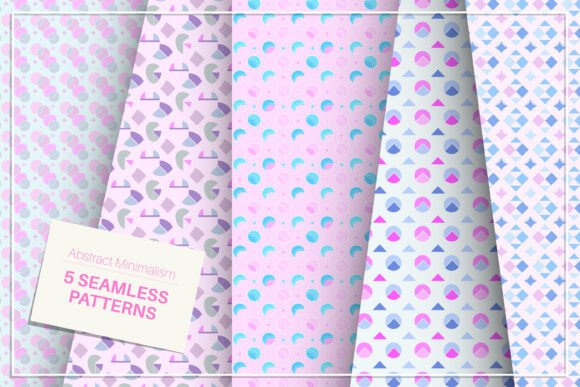
At its core, this resource features five seamless patterns built on abstract, minimalist designs. The palette relies heavily on gentle pinks, calming blues, and neutral grays. By using geometric shapes like circles, crescents, and triangles, the designs achieve a balance between playful energy and professional restraint. When you see these patterns displayed with gentle folds—suggesting fabric or wallpaper—you immediately understand their versatility. They aren’t flat digital artifacts; they feel tactile, ready to be wrapped around products, printed on stationery, or used as subtle textures in web design.
Why Minimalist Pastels Work in Modern Design
Before diving into specific use cases, it helps to understand why this aesthetic resonates so strongly right now. We live in an era of information overload. Users are bombarded with high-contrast ads, neon notifications, and cluttered interfaces. A pastel color scheme acts as a visual breath of fresh air. It reduces cognitive load and creates a sense of calm.
The combination of pink, blue, and gray is particularly powerful because it is gender-neutral yet emotionally warm. Pink brings warmth and creativity, blue offers trust and stability, and gray grounds the composition with sophistication. When paired with simple geometric shapes, the result is a pattern that feels intentional rather than accidental. This makes Pastel Color Patterns - 5 Variations ideal for brands that want to appear friendly and accessible without sacrificing credibility.
Real-World Applications for Creators and Entrepreneurs
Let’s look at how different professionals can actually use these files. Whether you are a freelancer pitching a client or a small business owner launching a new product line, these patterns solve specific problems.
Branding and Identity Packages
If you are building a brand identity from scratch, consistency is key. These five variations provide a unified family of assets. Imagine designing a logo on a white background, then using one of the pastel geometric patterns for the back of business cards, the lining of packaging boxes, or the footer of email newsletters. Because the colors are muted and the shapes are abstract, they complement logos rather than competing with them. For a boutique skincare brand, for instance, the soft pink and blue tones can evoke cleanliness and serenity, while the gray adds a touch of clinical reliability.
Digital Product Design
For bloggers, app developers, and UI/UX designers, whitespace is precious. Sometimes, a solid background feels too stark, but a busy photo distracts from the content. Here, Pastel Color Patterns - 5 Variations shines. Use them as low-opacity overlays on websites to add texture without reducing readability. In mobile apps, these seamless patterns can serve as subtle backgrounds for settings pages, loading screens, or empty states. The vector nature of the files (Ai and EPS) means they scale infinitely, ensuring crisp edges whether you are designing for a smartwatch screen or a large desktop monitor.
Print-on-Demand and Merchandise
Entrepreneurs selling on platforms like Etsy or Redbubble know that print quality matters. The "fabric-like" fold effect shown in the preview isn't just for show; it hints at how the pattern behaves on textiles. If you are creating phone cases, tote bags, or throw pillows, these seamless patterns tile perfectly. There are no awkward breaks or visible seams when the pattern repeats. This is crucial for commercial viability. A customer buying a notebook doesn’t want to notice where the pattern starts and ends. The geometric simplicity ensures that even if the item is viewed from a distance, the overall impression remains clean and polished.
Educational and Corporate Uses
It’s easy to assume pastel patterns are only for lifestyle brands, but their utility extends far beyond aesthetics. Educators and corporate trainers often struggle with making presentations engaging without being childish.
- Presentations: Slide decks often suffer from "death by bullet point." Using one of these patterns as a slide master background can instantly refresh a standard template. The gray-based patterns work well for data-heavy slides, providing a neutral canvas for charts, while the pink or blue variations can highlight key takeaways or section dividers.
- Workshops and Materials: If you are hosting a workshop, having handouts, certificates, or name tags that feature these designs elevates the perceived value of the event. It signals attention to detail. For example, a certificate of completion printed on paper with a subtle geometric border looks more prestigious than one on plain white stock.
Technical Considerations and Workflow
One of the biggest advantages of choosing Pastel Color Patterns - 5 Variations is the file format. You get both AI and EPS vector files. Why does this matter? Because raster images (like JPEGs or PNGs) pixelate when enlarged. Vector files do not. This allows you to experiment freely.
You might start by placing a pattern in a social media post. Then, decide to use the same asset for a billboard. With vectors, you don’t need to hunt for a higher-resolution version later. You simply open the AI or EPS file in Adobe Illustrator, Affinity Designer, or even Canva (with some import steps), and resize it to any dimension. This flexibility saves time and money, especially for freelancers who manage multiple projects simultaneously.
However, there are practical things to consider before applying these designs. First, always check the contrast. While pastels are soft, text placed directly over them must remain legible. It is often best to place text inside a solid-colored box or use a drop shadow if the pattern has darker elements. Second, consider the medium. A pattern that looks beautiful on a screen might behave differently on matte paper versus glossy cardstock. Always print a test sample if you are moving from digital to physical production.
Choosing the Right Variation
With five distinct options, you have plenty of room for customization. Here is a quick guide to help you choose based on your immediate needs:
- The Circle Pattern: Circles suggest community and continuity. This variation is excellent for wellness brands, childcare services, or community-focused organizations. It feels inclusive and safe.
- The Crescent Pattern: Crescents introduce movement and fluidity. Use this for creative agencies, travel blogs, or lifestyle influencers. It adds a dynamic element that static shapes lack.
- The Triangle Pattern: Triangles imply direction, growth, and stability. This is a strong choice for tech startups, financial planners, or educational institutions looking to convey progress and structure.
- Mixed Geometric Variations: Some patterns may blend these shapes. These are versatile all-rounders, perfect for general-purpose branding where you need a balanced mix of angles and curves.
The key is to match the psychological weight of the shape to your message. Do you want to feel steady (triangles/gray) or flowing (crescents/pink)? The color palette supports this emotional cue, allowing you to fine-tune the vibe without changing the underlying structure.
Final Thoughts on Integration
Incorporating Pastel Color Patterns - 5 Variations into your workflow is less about adding decoration and more about enhancing usability and appeal. It bridges the gap between sterile minimalism and chaotic complexity. For the everyday user, it simplifies the design process by providing pre-made, harmonious assets. For the professional, it offers scalable, high-quality resources that save hours of creation time.
Whether you are refreshing a blog’s aesthetic, preparing marketing materials for a small business launch, or designing a unique gift package, these patterns provide a reliable foundation. They remind us that good design doesn’t always need to be loud. Sometimes, a quiet, well-structured pattern in soft pink and blue is exactly what the audience needs to stop scrolling and pay attention.